



Plus Sizing
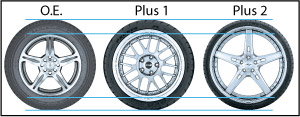
The terms Plus Sizing and Plus Fitment are used inter-changeably to describe fitting tires that are wider and of lower aspect ratio than were Original Equipment on a vehicle. Frequently, they’re used when speaking about the process generically. Since most “plus” fitments require switching to larger-diameter wheels, people just naturally started plugging the size increase in with the “plus”. So it’s common to hear people talk about Plus Zero, Plus 1, Plus 2, or Plus 3 Fitments. Plus Zero fitments do not always require new wheels depending on the new tire size being fitted. You must always stay within the rim-width range for the new tire which may require wider rims. Plus 1 fitments use rims one inch larger in diameter than O.E. Plus 2, two inches larger than O.E., and Plus 3, three inches larger than O.E.
Advantages to Plus Sizing
Your advantage comes from the larger footprint of wider tires. However, simply switching indiscriminately to wider tires can cause all sorts of problems, ranging from tire rub and possible failure, to speedometer error and interference with ABS systems. On the other hand, properly done Plus Sizing does away with most of these concerns. It accomplishes this through simultaneous changes of section width, aspect ratio, and rim diameter – without causing any significant change in overall tire diameter. However, it does not automatically eliminate the need to physically check for potential tire rub or damage. The major advantages of Plus Sizing can include substantial improvements in stability, traction, braking, handling and enhanced appearance. However, as numerous and sizable as the benefits of Plus Sizing are, there are several drawbacks. Most noticeable of these is a somewhat harsher ride that is a direct result of the shorter, stiffer sidewalls. The shorter sidewalls also mean that the tires and wheels are more vulnerable to impact damage from potholes, railroad tracks, and other road hazards. The increased width of plus-sized tires tends to increase the likelihood of rubbing against body panels or suspension components. In addition, moving to larger wheels generally means an increase in unsprung weight, which can translate into somewhat slower acceleration and decreased ride comfort.
Plus-sizing Guide and Procedures
One of the first things to do when helping a customer move up to a plus fitment is physically to look under the vehicle and assess clearances and potential problem areas that may exist. Doing that will quickly help you determine the room you have to play with and what you can do with it. Failure to do it can waste a lot of your time – and cost your customers. IMPORTANT:When replacing tires and/or wheels, you must always keep the rim width within the range approved for the tire size. See “Approved Rim-Width Range” provided on each product data sheet. Going outside of the recommended rim-width range subjects the tires to stresses for which they were not designed. This can cause a variety of problems, including premature tire wear, tire rub and damage, poor handling, or even tire failure. If the customer wants maximum performance, pick a size at the wide end of the range. Stick to the middle of the range to give your customer the best balance of handling, ride comfort, and tread wear. Note: Section width increases 0.2 in. for every 0.5 in. increase in rim width from the specified measuring size. This is particularly important when making changes on vehicles where clearances are tight.
Wheel Load Capacity
Warning! Just as tires have maximum load capabilities, so do wheels. Every wheel has a load capacity and psi limit. Prior to installing any tire on a wheel, make sure the wheel load capacity is equal to or greater than the maximum load and psi of the tire. If the wheel load capacity and psi are less than that of the tire, the wheel may fail suddenly during mounting or while in service. Wheel load capacity is usually stamped on the inner part of the wheel.
Plus-sizing Formulas
If you haven’t done plus sizing before, it might seem complicated. However, it’s not as difficult as it might seem. Once you’ve looked under the vehicle and determined what the room available will allow you to do, and talked with the customer to determine what he or she is after, there are some simple guidelines that you can follow. The rule of thumb for a Plus Zero fitment, is to increase section width by 10 mm and drop aspect ratio by 5 points. Rim diameter stays the same. You can switch to different wheels if the customer desires, but be careful about changing the offset, which can cause problems with clearances and stresses on suspension components. Do not change offset more than 12mm (0.472 in.) one way or the other from the Original Equipment specifications. A Plus Zero fitment for a vehicle that came with P185/65R14 tires as Original Equipment would be a P195/60R14. Plus 1 fitments require a section-width increase of 10mm, a reduction in aspect ratio of 10 points and an increase in rim diameter of one inch. For example, a vehicle that came with P185/65R14 tires as Original Equipment, a Plus 1 fitment would be 195/55R15 85V. Plus 2 calls for a 20mm jump in section width, a 20-point drop in aspect ratio and a two-inch increase in rim diameter. The fitment here would be a 205/45ZR16 87W.
Extreme Plus Sizing Requires Close Attention
Plus 3 or more (tuner sizes): Plus sizing formulas do not always provide the best choice for Plus 3 (or more) applications. As an example, let’s look at a Honda Civic that comes with size P185/70R14 87S as Original Equipment. At the 30/30 psi (front/rear) specified by the OEM, the load-carrying capacity required for the tire is 1109 pounds. If the rules of thumb worked beyond Plus 2, you would add 30 mm to the section width, subtract 30 points from the aspect ratio and add three inches to the rim diameter. You would expect the new size to be 215/40R17. However, that size in a standard load has a maximum load-carrying capacity of 1074 pounds at 36 psi. It falls 35 pounds short of the O.E. load-carrying capacity of 1109 pounds. Since you should never fit tires with a load-carrying capacity lower than the vehicle manufacturers specifies, the 215/40R17 size in standard load is not acceptable. However, the Toyo Proxes 4 in size215/40ZR17 87W is reinforced and will sufficiently carry an equal or greater load of 1109 pounds when the tires are inflated (cold) to 39/39 psi (front/rear). Note: Rim width and wheel offset are critical for this application. Consult Toyo or your wheel manufacturer. Keep in mind that you must do everything listed for a particular plus fitment. As you can see, Plus 3 or more (tuner sizes) can be confusing. It is important to check load-carrying capacity and overall diameter very carefully.
Body and Chasis Clearance
Ensure sufficient body and chassis clearance under all service conditions. If replacing with tires and/or wheels that differ from the original equipment specifications, all clearances between the tires/wheels and the vehicle’s components need to be checked, including the full suspension travel for both front and rear applications and the full range of load and cornering conditions. If the replacement tires/wheels come in contact with any of the vehicle’s components, both the components and replacement tires/wheels must be removed and examined for damage and possible replacement. This contact can cause damage to the tire or the vehicle which could lead to tire disablement or vehicle damage. Note: Clearance for the use of tire chains should also be considered.
ABS-Equipped Vehicles
It’s no secret that today’s vehicles rely heavily on computers for an ever-increasing list of functions. These computers, in turn, are dependent on a variety of sensors and other sources throughout the vehicle for information that is essential to their operation and accuracy. Some of the most important information centers on the rotation of the tires.
Among other things, this information tells the computers how fast to think the vehicle is going: and how far it has gone. An error in this data can lead to a number of problems. Some problems are relatively minor, such as in accuracy in the speedometer and odometer. Others, though, can be as serious as preventing the vehicle’s anti-lock brake system or traction-control system from functioning properly. For that reason, you must always keep the overall diameter of newly installed tires within a tolerance of plus 3 or minus 3 percent of the Original Equipment tires’ overall diameter. Always refer to the 5 guidelines when recommending substitute tire sizes:
-
- Always recommend a tire that has a load-carrying capacity and speed-rating that is equal to or greater than the O.E. tire.
- For any application, do not change overall diameter by more than plus 3 percent or minus 3 percent.
- Never use an inflation pressure lower than what is recommended by the vehicle manufacturer.
- Always maintain any differences in inflation pressures from front to rear that are shown on the vehicle placard.
- Vehicles equipped with ABS and/or traction-control systems, should not be fitted with tire sizes that differ from front to rear, unless the vehicle came with a staggered fitment as Original Equipment.