



Maximum Load and Inflation
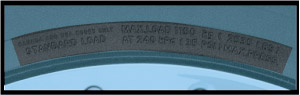
A tire’s maximum load-carrying capacity and inflation pressure are molded into the sidewall directly following the size information.
A P-Metric tire’s capacity is identified as either Standard Load or Extra Load. Standard Load tires are limited to the weight they can carry with a maximum inflation pressure of 35, 44 or 50psi as shown on the tire sidewall. They do not carry any special designations. Extra Load tires are branded “Extra Load” and are limited to the load they can carry with a maximum inflation pressure of 44 or 50 as shown on the tire sidewall.
Some tires are “reinforced”. Reinforced tires carry higher loads at higher pressures and may be required for some plus fitments to meet the vehicle’s load requirement.
Important: Many people believe that the proper air pressure is the one molded onto the sidewall of the tire (such as 35 psi or 50 psi). This is not correct. Inflation pressure on the sidewall of the tire is the maximum pressure for the tire. Remember, the car, not the tire sidewall markings, determines the correct inflation pressure.
P-Metric Tires Used for Trucks
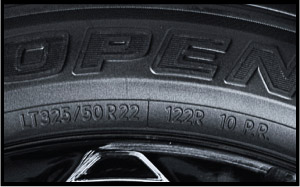
The prefix letters “P” and “LT” are used as part of the tire size designation to differentiate between tires designed for service on Passenger cars or Light Truck vehicles. The load/inflation formulas developed for “LT” tires are different from those for “P” tires, since it is expected that “LT” tires will experience more severe loading and operating conditions.
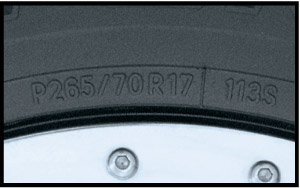
If the vehicle’s tire information placard calls for “LT” tires, you should replace them with the same size and type tire with an “LT” prefix. If the customer prefers to use a “P” tire as a replacement on a light truck, it MUST have at least the same load carrying capacity as the tire it replaces.
When P-metric or metric size designation tires are applied to light trucks (SUV, pickup, minivan), the tire’s load capacity is reduced by a factor of 1.1 at any inflation value. For example, size 305/50R20 has a maximum load engraved on the sidewall of 3,086 pounds. If the tire is to be fitted to a light truck, the actual allowable load for the tire is 2,805 lbs. (3086 divided by 1.1). This reduced load must be equal to or greater than the load of the original tire at the specified tire placard pressure in order to maintain the vehicle’s load safety factor. This load reduction factor is not necessary for “LT” designated tires.
If you are replacing tires on a light truck with the exact same type (P-metric, or metric designation), size designation and load range, the vehicle manufacturer has already considered the load reduction factor and no further discounting of the load is necessary.
Attention! Matching Tires on Four-Wheel Drive and All Wheel Drive Vehicles: 4WD and AWD vehicles require special attention to ensure that all four tires are closely matched in diameter to avoid strain and possible damage to the vehicle’s differentials and/or viscous couplings. Tire inflation pressure also affects the tire’s rolling circumference and should be matched according to the vehicle manufacturer’s recommendations. Always check the vehicle manufacturer’s recommendations prior to installing new tires.