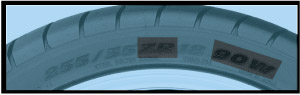


Service Description
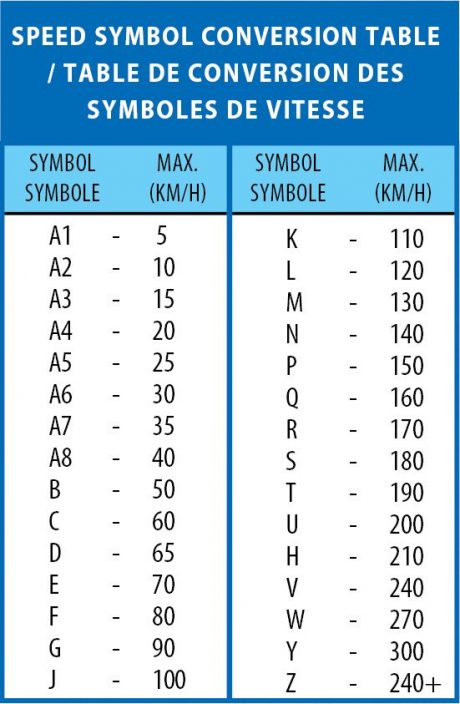
Another of the recent developments in the standardization of tire information is the service description. Typically it is made up of a two, or three-digit load index symbol (which indicate the tire’s maximum load-carrying capacity) plus a single-letter speed symbol, which designates its maximum speed capability. This information is found as a unit, and is molded at the end of a tire’s size designation. Service descriptions apply only to Q, R, S, T, H, W, Y, and limited V rated tires.
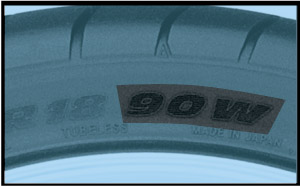
Load Index
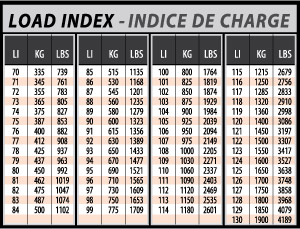
The load-carrying capacity of a tire is described in its load index. This is a one, two, or three-digit number. Each number corresponds to an assigned maximum load limit, which varies depending on whether the tire follows design standards from the Tire and Rim Association (TRA) or the European Tyre and Rim Technical Organization (ETRTO). When placed together with the speed symbol (also called speed rating), the resulting combination is known as the service description. This is molded into the sidewall of the tire, and makes up the final element in the size designation.
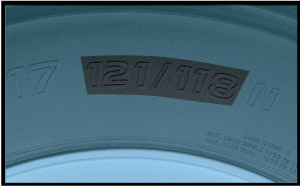
Dual Load Indexes
Some light truck tires (i.e. LT-Metric) have two load index values on the sidewall, such as 120/116. The first load index applies to single tire fitments and the second load index applies when the tire is used for dual assemblies. When LT tires are fitted in dual assemblies, the load capacity is reduced by 9% of the single load capacity to account for the affect of road crown.
Note: LT-Metric designation sizes are based on standards from the Tire and Rim Association (TRA). These standards are NOT interchangeable with those from the European Tyre and Rim Technical Organization (ETRTO).
Speed Ratings
Most passenger tires sold in Canada in the past few years have been rated S, T, H, V, or Z. Recent requirements to the system added the W category for speeds up to 270 KM/H (168 mph) and Y for speeds up to 300 KM/H (186mph). The system for speed ratings originated in Europe where countries such as Germany have very high speed limits on certain highways. Speed ratings are determined by indoor laboratory testing methods which measure high-speed tire durability under controlled test conditions. These test procedures do not take into account underinflation, tire damage, vehicle characteristics, or road conditions which can lead to sudden tire failure or loss of vehicle control at much lower speeds than indicated by the tire’s speed rating.
The validity of using speed rated tires in Canada is based on the idea that the tire’s top speed capability must at least equal the vehicle’s top speed capability, since it cannot be assumed that the driver will always observe the speed limit.
Speed Ratings are Shown On A Tire In One of Three Ways
Notes:
-
- For Open Ended V and Z tires, (when there is no service description) always consult the tire manufacturer for maximum speed.
-
- Original Equipment tires must always be replaced with tires of the same or higher speed rating. Failure to do this lowers the speed capability of the vehicle to that of the tire with the lowest speed rating.
-
- Mounting tires with higher speed ratings than Original Equipment does not necessarily increase the vehicle’s speed capability.
-
- When Z appears in the tire size with a service description (205/45ZR16 83W), the maximum speed is indicated by the speed symbol in the service description (270 KM/H in this example). Always consult the tire manufacturer for maximum speed capability when there is no service description.
WARNING! Tires must never be operated in excess of their rated speed limit. Exceeding the tire’s speed capability will cause overheating of the tire and sudden failure, possibly leading to loss of vehicle control. Toyo passenger and light truck tires have a maximum speed rating depending on size and type. Consult your tire dealer or contact Toyo Tire at 1-877-682-8696 if you are not sure about the maximum speed rating of your tires. Toyo Tire Canada Inc. does not endorse the operation of any vehicle in any unsafe or unlawful manner. Tire speed ratings do not imply that a vehicle can be safely driven at the speed for which the tire is rated. Speed ratings are based on laboratory tests which relate to performance on the road, but are not applicable if tires are underinflated, overloaded, worn out, damaged or altered.